agents
Written on 11 November, looking back on the night before theme night. Times are Dutch local time.
Why a board at all
On theme night the maker gets 45 minutes with paper and pen, and nobody else suggests anything. A board of existing ideas could easily steer that, so we put it on the first note: this is for looking things up afterwards. The sketches decide, not the board.
How it is built
Each section is a genre: action, tower defense, strategy, roguelike, incremental, simulation, survival, puzzle, platforming, RPG, exploration, horror and stealth, racing, rhythm, party and co-op, cards. Two more sections hold crossovers and five basic shapes of a game loop. Arrows link notes that share a verb or could be combined.
The colour of a note is how feasible it is in 72 hours on our route: Unreal Blueprint driven by scripts, one ready-made character, a level from our 3D pipeline, no interface screens and no timelines. We measured that navigation, moving to a point and jumping work. works
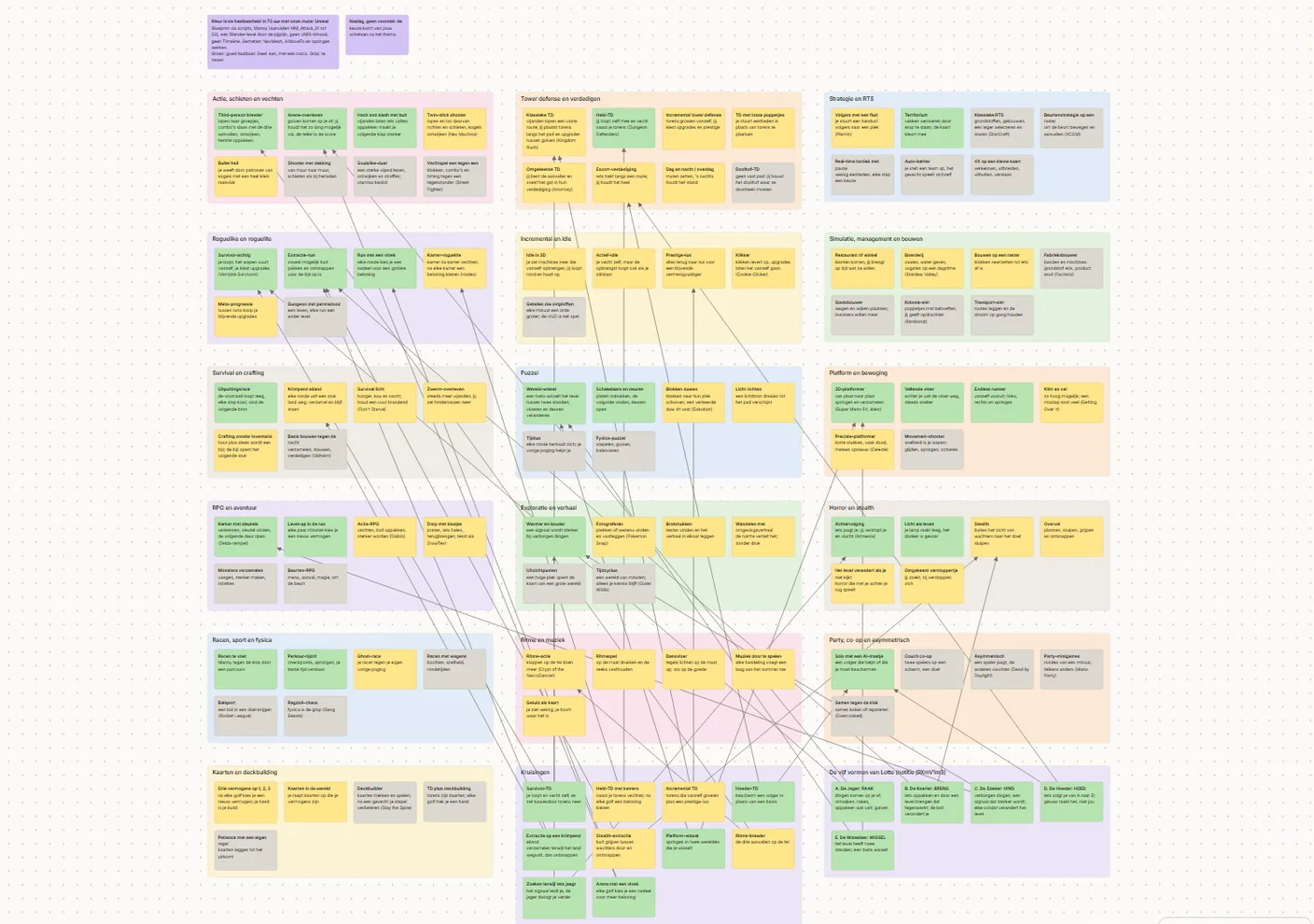
A few examples
- Action: a brawler where you walk to a group and chain three attacks is green. A one-on-one fighting game, which lives on frame-exact timing, is grey.
- Tower defense: a hero who fights beside the towers is green. A maze you build yourself, with enemies finding their way through, is grey.
- Roguelike: a survivor type, where the weapon fires by itself and you choose upgrades, is green. Permanent death with a new level every run is grey.
- Crossovers: a survivor game where you also place towers is green. A rhythm brawler, with attacks on the beat, is yellow.
The colour says what we can build, not what is good.
The checklist for the evening
For each sketch, about eight minutes, all sketches first and only then sharpening:
- The verb: one word for what the player does.
- What does the player do every ten seconds, and would he do it again?
- The block test: swap all art for grey blocks; is the theme still in the rules?
- Where does the reward fall, and how often?
- The five-second test: does a viewer get it from five seconds of video?
- Score the jury's seven points from 1 to 5.
not proven yet Whether this fits 45 minutes of sketching and doubt. We find out on the evening itself.
What happens on the night
At 20:00 the theme is announced. Then 45 minutes of sketching on paper, three to five ideas. Only after that does the board come out, as reference, and the checklist is run over what the maker drew.